Carpenter ant colony elimination requires an exacting diagnostic approach across Cuyahoga County's historic housing inventory. Unlike termites, Camponotus pennsylvanicus workers do not consume wood fibers; instead,…
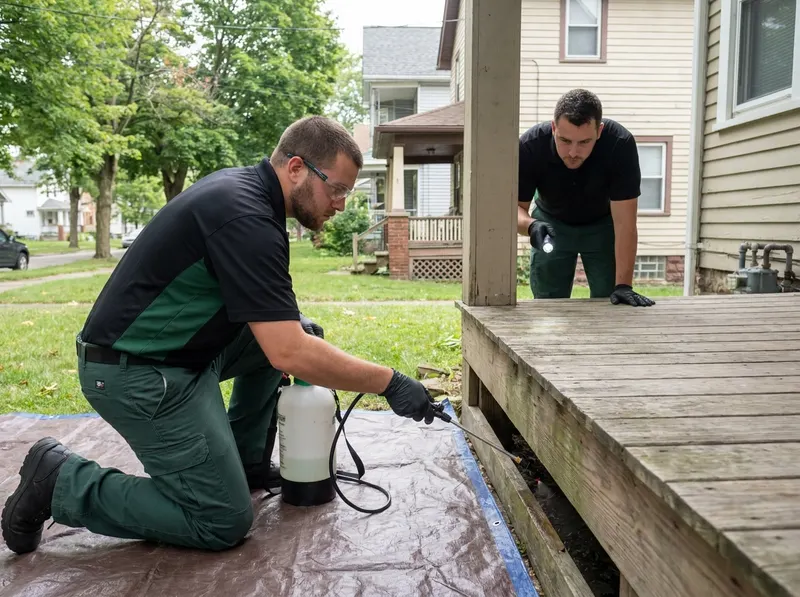
Carpenter ant colony elimination requires an exacting diagnostic approach across Cuyahoga County's historic housing inventory. Unlike termites, Camponotus pennsylvanicus workers do not consume wood fibers; instead, they excavate gallery networks through water-damaged structural timbers to rear brood. In historic balloon-framed properties across Ohio City, Tremont, and Detroit-Shoreway, these galleries frequently nest inside original damp subflooring, wall studs, and porch structural supports. Our team utilizes directional non-repellent formulations and micro-injection equipment registered under the EPA Federal Insecticide, Fungicide, and Rodenticide Act to safely dismantle parent nests hidden behind drywall without aerosolizing toxic residues across residential living spaces.
Structural moisture remains the primary catalyst for active infestations along Lake Erie microclimates. In lakefront districts such as Edgewater and Collinwood, wind-driven moisture penetrates masonry lintels, while early 20th-century residential structures in Old Brooklyn, Slavic Village, and Glenville often conceal chronic plumbing leaks behind plaster lath. When field technicians trace carpenter ant trails, we identify the high-moisture timber intersections prioritized by the International Association of Certified Home Inspectors for moisture testing. Applying over-the-counter pyrethroid sprays scatters foraging workers into uninfested structural bays, a physiological response known as colony budding. Successful elimination relies entirely on slow-acting biological disruptors governed by the Pest Control Technology guidelines, permitting returning foragers to distribute active transfer agents into the heart of the primary queen gallery.
Eradicating these wood-destroying colonies follows an established, clinical sequence to permanently clear the home:
Deciding between targeted void treatments and whole-structure exclusion treatments depends on colony maturity. A localized satellite nest occupying a bathroom header in Kamm's Corners or University Circle requires localized void injection, avoiding structural disruption. Conversely, multi-satellite infestations migrating between exterior tree cavities and interior sill plates require whole-perimeter barrier chemistry and arbor exclusion. The trade-off centers on project scope: targeted void injection delivers immediate disruption to indoor satellite galleries, while continuous perimeter barriers guarantee protection against foraging workers traveling up to 300 feet from outside ground sources. Elmwick Extermination adheres strictly to the structural standards outlined by the National Pest Management Association, the worker health protections of the Occupational Safety and Health Administration, the ecological guidelines of the U.S. Fish and Wildlife Service, residential protection advice from the U.S. Department of Housing and Urban Development, and regional pest control protocols documented by The Ohio State University Extension. Inquiries and dispatch arrangements are handled directly at (216) 682-2079.
Every job gets a firm, written price after an on-site visit.
Tell us about your carpenter ant colony elimination job in Cleveland and we'll send a clear, written quote, usually the same day.
 Elmwick Extermination