Crawling arthropod perimeter defense addresses structural migration pathways in older Cleveland housing stock, where moist basement foundations intersect with damp topsoil. In neighborhoods like Detroit-Shoreway,…
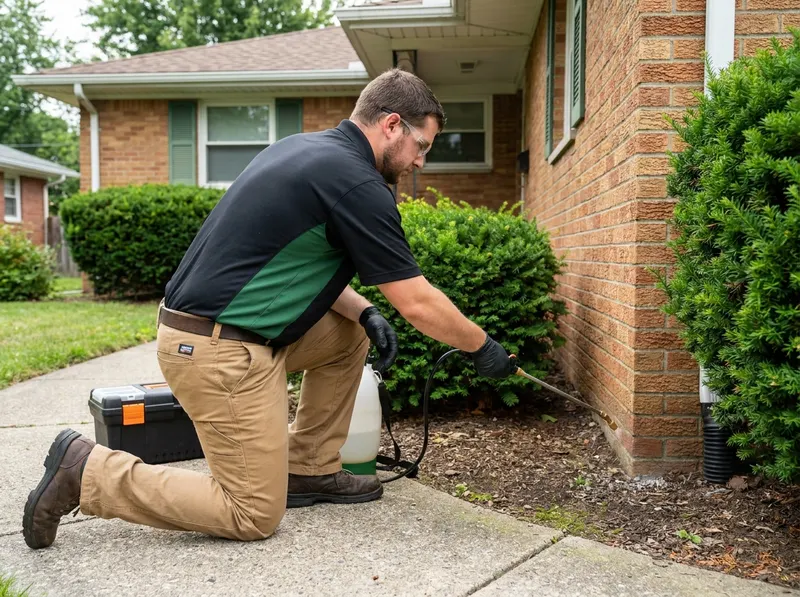
Crawling arthropod perimeter defense addresses structural migration pathways in older Cleveland housing stock, where moist basement foundations intersect with damp topsoil. In neighborhoods like Detroit-Shoreway, Edgewater, and Slavic Village, sandstone footers and aged brick masonry frequently develop micro-fissures. Crawling arthropods, specifically house centipedes (Scutigera coleoptrata), European earwigs, and woodlice, migrate inward when outside humidity levels drop or when sustained rainfall saturates exterior mulch beds. Installing an exterior chemical barrier halts entry before insects reach interior floorboards, drywall voids, or basement utility rooms, preventing nocturnal indoor sightings without requiring broadcast interior spraying.
Treatment selection depends on structural materials and grading slope around the dwelling. When foundation walls consist of unfinished concrete or dense limestone, liquid microencapsulated pyrethroids adhere securely to masonry pores. Conversely, for historic residences in Tremont or Ohio City with unsealed fieldstone basements, hydrophobic granular applications across perimeter gardens provide longer stability against runoff, complying with EPA pesticide standards for ground-surface migration control. A dedicated perimeter treatment is ideal for preventing seasonal interior migrations; if an active interior nest of carpenter ants or wood-boring pests has already established inside walls, targeted interior structural drilling becomes necessary alongside perimeter work. The trade-off of an exterior perimeter defense is environmental degradation from lake-effect rainfall, which necessitates seasonal reapplication every 60 to 90 days to maintain active residual protection.
Execution follows an exact five-step remediation protocol to establish safe, non-repellent zones:
Properties situated near shaded municipal green spaces or coastal park environments, such as homes bordering University Circle, Old Brooklyn, Collinwood, Kamm's Corners, or Glenville, experience elevated arthropod density due to damp organic loam. The Ohio Department of Agriculture (agri.ohio.gov) oversees structural pesticide applicators under Ohio Revised Code Chapter 921, requiring strict compliance with target rates. Additionally, following OSHA chemical handling protocols and safety parameters from the National Pest Management Association (pestworld.org), materials are applied specifically to resting surfaces, keeping domestic living quarters uncontaminated for children and pets. When addressing perimeter dampness, structural integration with guidelines from the American Society of Home Inspectors (homeinspector.org) and basement moisture controls defined by the National Association of Home Builders (nahb.org) helps lower exterior humidity vectors. Elmwick Extermination delivers this defense with quiet, unbranded operational vehicles, confirming precise property pricing on-site prior to product application. Direct service coordination is available by calling (216) 682-2079.
Every job gets a firm, written price after an on-site visit.
Tell us about your crawling arthropod perimeter defense job in Cleveland and we'll send a clear, written quote, usually the same day.
 Elmwick Extermination